What a Camera Feeder Actually Does
October 17, 2026
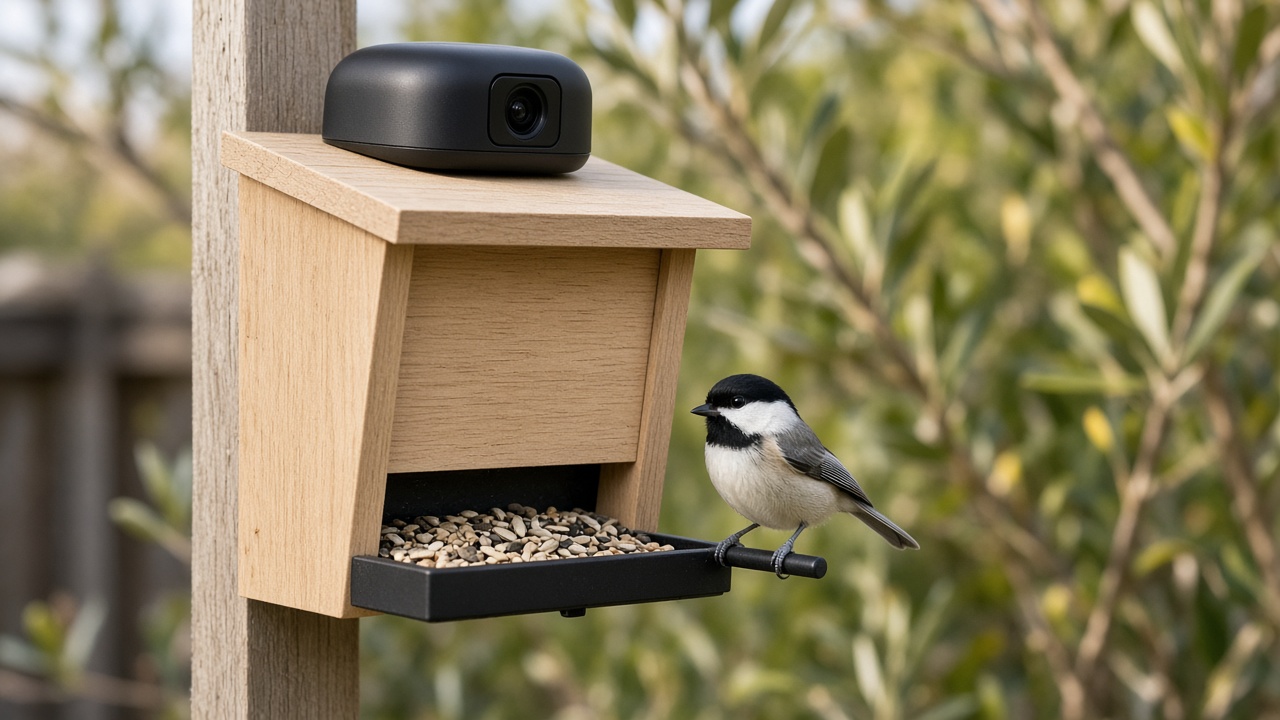
A camera feeder is a feeder with a lens and an app. That is the whole category. The camera can sit in the roof, over the tray, or in a small housing aimed at the perch. When a bird lands, the device records a still or a short clip and sends it to a phone. Some makers add a label: this is a chickadee, this is a goldfinch. The label is software. It is not a biologist standing in the yard, and it is not the Cornell Lab's Merlin, which is a separate identification tool you can use to check a photo yourself.
Two makers describe their own machines in public, and those descriptions should be read as claims, not as a test. Birdfy's affiliate page says the company sells AI-powered smart bird feeders with 4K cameras, along with bird houses and hummingbird feeders. Bird Buddy's partner page says the feeder notifies you, takes photos, and that its software can recognize over 1,000 species. This Journal has not weighed those claims against a season of known birds. A review that pretends otherwise would be fiction filed in the wrong column. What can be said is what the machines are for, and what they do not replace.
They do not replace seed. The Cornell Lab's seed guide still starts with black oil sunflower if you want the widest mix of birds, and it still warns that mixes full of red millet, oats, and other fillers get picked through and then mold. Nyjer still belongs in a tube with small ports if goldfinches are the point. Safflower still suits cardinals on a tray or a hopper, with the caveat that some House Sparrows, starlings, and squirrels have learned to eat it. A camera on the roof does not change any of that. If the tray is full of filler, the camera will record birds tossing filler on the ground.
They do not replace cleaning. Project FeederWatch's account of salmonellosis is blunt. The bacteria pass in droppings onto food and water, sick birds may look thin or oddly fluffed and easy to approach, and some birds carry it with no sign you can see. Pine Siskins, redpolls, and American Goldfinches show up in the outbreaks. House Finch eye disease, caused by Mycoplasma gallisepticum, shows up as red, swollen, crusty eyes and has spread to goldfinches, Evening Grosbeaks, and Purple Finches. A camera will sometimes be how you notice a sick bird. It will not disinfect the perch the bird just used.
The cleaning evidence is ordinary and a little tedious, which is the right tone for it. A Wilson Journal of Ornithology study, summarized by FeederWatch, put Salmonella on feeders and compared soap and water, a ten-minute dilute bleach soak, and soap followed by bleach. The bleach soaks cut the bacteria more. Feeders that still had debris stayed dirtier no matter the method, and debris plus soap alone could leave enough bacteria to matter. FeederWatch's instruction is to scrub off anything you can see, soak or scrub with dilute bleach, rinse, and dry before you add seed. Audubon's winter piece, quoting Emma Greig of FeederWatch, says a dishwasher is fine if the feeder can take it, and that a damp feeder is how fungus and bacteria get ahead of you. The same piece suggests soap, then a vinegar soak, then a rinse, and a cleaning rhythm of about every other week, more often if the birds are heavy. Audubon's older feeding tips say at least spring and fall, and more often in a humid summer, with a non-chlorine bleach soak. The recipes are not identical. The shared point is that a camera feeder has perches, a seed well, and corners, and those have to come apart.
They do not replace a decision about glass. Birds hit windows because the glass reflects trees and sky, or because they can see habitat through it. The Cornell Lab cites a 2014 study for a toll of up to about a billion birds a year in the United States. Christine Sheppard of the American Bird Conservancy told the Lab that the old "safe distance" for a feeder is no longer considered valid. If the feeder is near a window, treat the window. Marks go on the outside, about two inches apart for small birds. Paracord can be four inches apart. A camera pointed at a perch does not make the slider behind it visible. If anything, a popular feeder puts more birds in the air next to the glass. The Fish and Wildlife Service still also tells people to keep feeders within about three feet so a startled bird cannot build speed. Read both. Then put a pattern on the outside of the pane.
They are a poor tool at a nest. A feeder camera watches birds that chose to land on a public tray. A camera in a nest box watches a bird that cannot leave its eggs. This Journal is not going to invent a rule the nest researchers did not write, and it is not going to bless a hole-cam because the feeder version is fun. If you want a box, read NestWatch before you drill the hole. The feeder and the box are different rooms.
What is worth checking, before anyone's app, is the feeder underneath the camera. Cornell's seed page and Audubon's feeding notes agree on the dull requirements. The box should keep seed dry. It should be easy to open and easy to scrub. Wood looks right and holds grime; plastic and metal are simpler to sanitize, which is the Cornell classroom feeder note. A perch that birds can coat with droppings will become the problem FeederWatch described, whether or not a lens is watching. Squirrels still want the sunflower. A baffle and a pole in the open, Audubon says about five feet up and ten feet from a jump, are still the mechanical answers. The app will not grow a baffle.
The species label is the part people buy. Treat it as a hint. Bird Buddy says "over 1,000 species." That number is the company's. It does not tell you the error rate on female house finches, or on a wet goldfinch in winter plumage, or on a bird at the edge of the frame. When the label matters, compare the photo with the Cornell species account, or with Merlin, and keep the photo. A wrong label that you believed is worse than no label. A right label is a pleasure and still not a citation.
There is a smaller, good use. A camera catches the visits you miss: the titmouse that takes one seed and leaves, which is the real Tufted Titmouse habit, or the goldfinch flock that arrives and is gone before you reach the window. It can show you a sick bird early enough that you take the feeder down. FeederWatch says to remove the feeders a sick bird is using for a couple of weeks, clean them, and let the birds disperse. Only a veterinarian or a federally licensed rehabilitator may treat a wild bird. Possessing one, without that direction, is illegal. The camera is a witness. It is not a clinic.
Buy the feeder the way you would buy a feeder. Dry seed, a perch you can wash, glass you have marked, a cat indoors. The camera is an extra eye. It is not a substitute for the yard.
Sources
- Birdfy affiliate program, maker's description
- Bird Buddy partner page, maker's description
- Feeding birds: a quick guide to seed types, All About Birds, Cornell Lab
- Sick birds and bird diseases, Project FeederWatch
- Preventing disease at feeders, Project FeederWatch
- How to feed birds safely this winter, Audubon
- 11 tips for feeding backyard birds, Audubon
- Why birds hit windows, All About Birds, Cornell Lab
- Bird-friendly home toolkit, U.S. Fish and Wildlife Service
- Tufted Titmouse, All About Birds, Cornell Lab
- Maintaining a classroom feeder, Cornell Lab K-12