The Yard, Season by Season
October 25, 2026
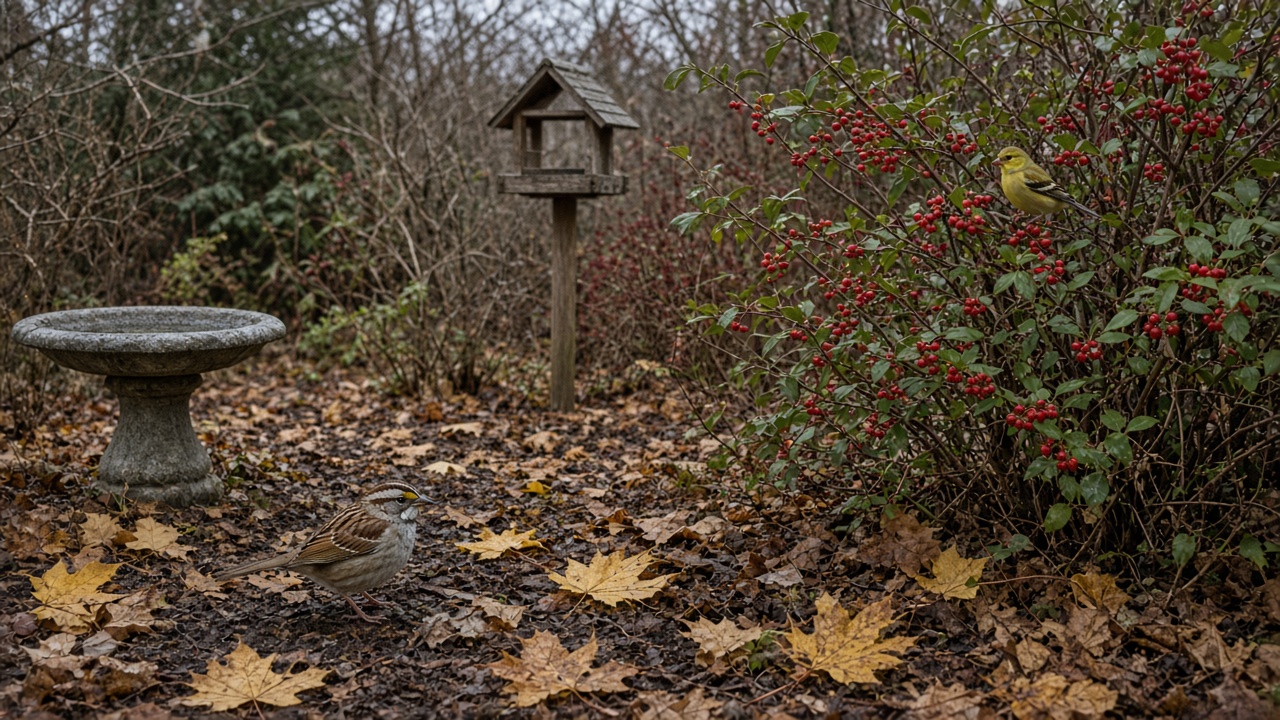
A backyard does not host one set of birds. It hosts a year, and the year changes what the birds are doing there. The Cornell Lab's account of window strikes is also, quietly, an account of the calendar. Collisions happen in every season and at any hour, and they bunch up at dawn and dusk in spring and fall, when migrants are leaving cover or dropping into it. Many of those travelers move at night. At dawn they come down to rest and eat. At dusk they leave again. A yard that looks empty at noon can be a busy place in the half hour the light changes.
The U.S. Fish and Wildlife Service puts a clock on the night flight. In North America, most of the birds that migrate at night are moving between about 10 p.m. and 4 a.m. in the peak weeks of spring and fall. They use the stars. Lights pull them off course. The Service's bird-friendly home notes ask for the practical version of that fact: turn off lights that are not needed, close the curtains so the rooms do not glow, and if a light has to stay outside, shield it downward and put it on a motion sensor. That is a fall and spring chore as much as a feeder chore. The birds you never quite see are the ones overhead.
Winter is the season people mean when they say "the birds at the feeder." The Lab's winter feeding note says that in spring and summer most songbirds eat insects, and that in fall and winter the birds that stay shift toward fruit and seed. Black oil sunflower is the seed that note, and the Lab's seed guide, both put first. The shells are thin, the kernels are fatty, and small birds can handle them. Striped sunflower is harder, which is useful when House Sparrows and blackbirds take over the tray. Mixes packed with red millet, oats, and other fillers get sorted. The birds eat the sunflower and leave the rest, and the leftovers mold. A winter hopper that holds one seed is less romantic than a bag with a picture of twenty species on it. It is also less waste.
Cardinals make the winter yard look occupied even when the migrants are gone. The range map on the Cornell species page is a year-round map across much of the East and into the Southwest. They are seed eaters. They use sunflower. They forage on the ground and in the low growth, and the Lab says that leaving undergrowth at the edge of a yard is how you keep a chance of them nesting on the place later. Winter feeding and a messy edge are the same project, stretched across months.
Goldfinches complicate the idea that the interesting season is winter. They are at feeders for sunflower and nyjer in the cold months, often in flocks, and the males are dull then. They molt body feathers twice a year, once in late winter and again in late summer, which is why the yellow seems to return rather than simply arrive. They also nest late. The species account says they wait until June or July, when milkweed, thistle, and other plants have made the fibrous seed they build with and feed to their young. A spring yard that is only a feeder is early for them. A summer yard with native thistle, other composites, and milkweed is the one that matches the calendar they actually use. Cornell says to plant those, and that almost any feeder, even one that swings, will still get goldfinches if the seed is right.
Summer is when suet becomes a bad idea. Audubon's feeding notes say to offer suet in cool weather only. In the heat it goes rancid, and fat that drips onto feathers can damage the waterproofing. The summer substitute in those same notes is peanut butter cut with a lot of cornmeal, packed into a pinecone or a log, for woodpeckers, chickadees, and titmice. Hummingbird nectar, if you offer it, is one part white sugar to four parts water, boiled briefly, with no red dye. The feeder has to be washed every few days with very hot water. That is a summer job with a short clock, not a feeder you fill on Memorial Day and forget.
Water belongs in every season and gets neglected in the pretty ones. Audubon's winter safety piece says to change bath water daily or every other day so it does not grow mosquitoes, algae, and bacteria, and to scrub with a vinegar solution and rinse. Put the bath where droppings and plant debris do not fall straight in, which means not directly under the feeder. In winter the bath is as much of a draw as the seed, because open water is scarce. In summer it is where the mosquitoes would be if you let the water sit.
The ground changes jobs too. In winter, white millet on a low tray or a thin scatter can feed native sparrows, doves, towhees, and juncos, and the Lab says not to put out more than the birds will finish in a day. The same seed feeds House Sparrows and blackbirds. If those birds already dominate, skip the millet. Corn is a worse bargain. Cornell lists it as the food most likely to carry aflatoxin, tells you never to buy it in plastic bags, never to let it get wet, and never to offer corn that has been dyed red for planting, because that dye marks a fungicide treatment that is toxic to birds. Summer humidity makes the storage rules stricter. Audubon says to keep seed in metal cans with tight lids, in a cool dry place, and not to carry a winter's leftover seed into the next year. Damp seed molds. Heat ruins sunflower.
Fall is the season of both abundance and bad glass. Migrants are leaving. Fruit on native shrubs is doing the work a feeder only imitates. The birds that hit windows are often doing it as they exit or enter vegetation, which is exactly what a berry shrub next to a reflective slider invites. Sheppard's advice, reported by the Cornell Lab, is to stop trusting distance. Older pages, including Audubon's 2011 feeding tips and the Service's home toolkit, still say to keep feeders within about three feet of glass, or in Audubon's winter piece at least 30 feet away, so a bird cannot build speed. Sheppard says that rule is no longer considered valid, and that a window near a feeder should be treated. The disagreement is in the sources. The safe reading is to treat the glass either way, on the outside, with marks about two inches apart, or with paracord about four inches apart, which is the spacing both the Lab and the Fish and Wildlife Service describe.
A yard through the seasons is not a list of species to collect. It is a short set of jobs that move. Winter asks for clean sunflower, a rake, and open water. Spring and fall ask for dark windows at night and glass a bird can see in the morning. Summer asks for no rancid suet, nectar that is washed, and plants that will still be seeding in July when the goldfinches are ready to nest. None of that requires a new bird every month. It requires noticing which month it is.
Sources
- Why birds hit windows, All About Birds, Cornell Lab
- Bird-friendly home toolkit, U.S. Fish and Wildlife Service
- Feeding birds: a quick guide to seed types, All About Birds, Cornell Lab
- Winter bird feeding PDF, Cornell Lab
- Northern Cardinal, All About Birds, Cornell Lab
- American Goldfinch, All About Birds, Cornell Lab
- 11 tips for feeding backyard birds, Audubon
- How to feed birds safely this winter, Audubon
- Simple solutions to prevent collisions, Audubon