Make the Glass Visible
November 2, 2026
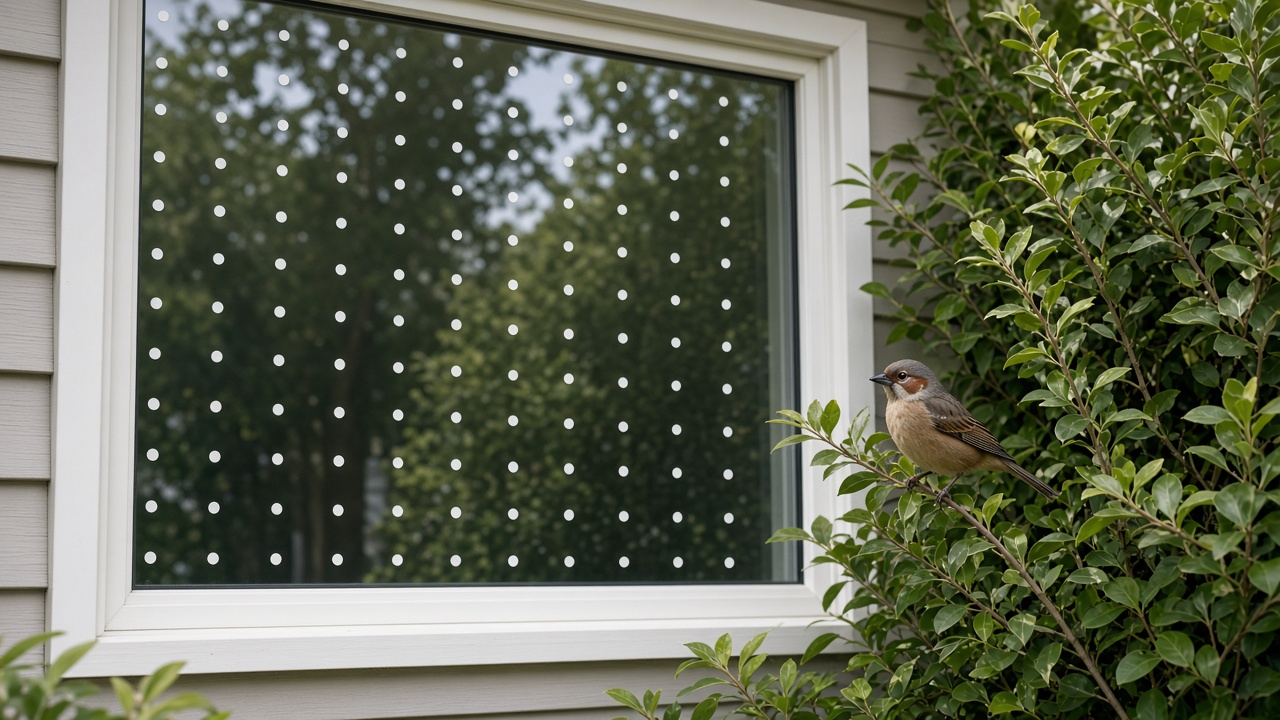
Glass is worse than invisible. A window that reflects trees or sky looks like a place to fly. A window you can see through, to a plant on the sill or to another window across the room, looks like a gap in the woods. Birds hit both. The Cornell Lab, citing a 2014 study, puts the toll in the United States at up to about a billion birds a year. The U.S. Fish and Wildlife Service says more than a billion, and says most of those collisions are at homes and other low buildings, because that is where the glass is. High-rises are not the main story. The slider in a kitchen is.
Many birds that hit and then fly off still die. Daniel Klem of Muhlenberg College, whose work the Lab summarizes, has made that point since the 1970s. The injury is often internal, including bruising of the brain, and it worsens after the bird has left the grass. A dusty outline of a bird on the pane, a thud, or a stunned bird under the window are the signs the Fish and Wildlife Service lists. The Service also says you will miss many strikes. If you know of a few, assume there are more.
The busy times are dawn and dusk in spring and fall. Migrants fly at night. At dawn they drop into vegetation to rest and feed. At dusk they leave. Either move puts them in front of reflections. The Fish and Wildlife Service says that in North America most of that night migration, in the peak weeks, falls between about 10 p.m. and 4 a.m. Lights pull birds off those routes, especially under low cloud. The Lab points to BirdCast and to city Lights Out programs for the large buildings. At a house the same idea is smaller. Turn off lights you do not need. Close the curtains so bedrooms do not shine. If a porch light has to stay, shield it down and put it on a motion sensor. Night lighting is not a substitute for treating the glass. A bird drawn into a lit neighborhood can still hit a reflective pane the next morning.
There is a milder version in spring. A territorial bird attacks its reflection. The Lab calls this reflection aggression. It is annoying and usually not fatal. The same outside treatments that stop strikes tend to stop the fight.
Start by going outside and looking at the glass the way a bird would. Large panes, windows that meet at a corner, and any window with a feeder nearby are the ones the Lab flags. If you see branches or sky in the glass, or through it, so does the bird. Then ignore the old comfort about distance. Christine Sheppard, who directs the American Bird Conservancy's collision program, told the Lab that past advice about a safe distance for feeders is no longer considered valid. Her line was to make the window bird-friendly and stop worrying about how far the feeder is. Other pages have not all caught up. Audubon's 2011 feeding tips still say to place feeders within three feet of the glass. Audubon's collision notes say research shows a feeder closer than three feet keeps a startled bird from building fatal speed. The Fish and Wildlife Service's home toolkit still says to keep feeders within three feet. Audubon's winter feeding piece says either within a very short distance or at least 30 feet away, because the middle distance is where a bird can accelerate. Those sentences are in the sources. Sheppard's correction is also in the sources, and it is the later word from the person who runs a national collision program. Treat the glass. Do not spend the afternoon with a tape measure and call it done.
Treatment goes on the outside. Marks on the inside can disappear behind the reflection. The Lab's spacing for decals, paint, tape, or dots, if you want to protect small birds including hummingbirds, is a uniform two inches across the whole pane. Acopian BirdSavers, the paracord curtains the Lab uses on its own building, can be four inches apart because the cords are easier to see. The Fish and Wildlife Service's standard matches the two-inch grid for markers on the exterior, and its home sheet also describes vertical stripes at least a quarter-inch wide and no more than four inches apart, or horizontal stripes no more than two inches apart, with a tighter two-by-two grid where hummingbirds are the concern. Hawk silhouettes do little unless they are dense enough to become a pattern. One or two stickers on a picture window are a decoration. The bird flies through the gap the way it flies through a tree.
The methods the Lab lists are ordinary. Tempera paint or soap on the outside, in a two-inch grid or a drawing you can still see through. Decals, tape, sun catchers, or sticky notes, with the same tight spacing. Commercial dot tape, including products sold for this purpose. Paracord hung from the top of the frame. A mosquito screen on the outside, covering the pane, which the Lab calls very effective. One-way film that looks opaque from the yard and still lets you see out, with some loss of light. For a remodel, the Lab likes exterior shutters you actually close, awnings, and windows whose screens already cover the glass. Interior blinds, half open, can help on a window the bird is trying to see through, and they fail when the danger is a reflection of the yard. Move houseplants back from the glass. A plant in the window is habitat on the wrong side.
If a bird is on the ground, the Lab's steps are specific. Approach from behind and cover it gently with both hands. Small birds are easy to crush, so the hold is secure and not tight. Put it in an unwaxed paper bag or a small cardboard box lined with a paper towel it can grip. Set the container somewhere dark, quiet, and warm, away from children and pets. Do not feed it, water it, or keep handling it. Wild birds treat people as predators. Find a rehabilitator, using the directory the Lab links through the Humane Society, and follow their instructions. If they tell you to release it, take it away from the building, open the bag toward cover, and watch the flight. A bird that cannot fly needs the rehabilitator again. FeederWatch's rule is the same legal line: you do not become the clinic.
The work is ugly for a day and then it is just the window. Dots, cords, or a screen. Lights off after dinner in April and again in September. A feeder you enjoy, in front of glass the birds can tell is there. The billion is a national number. The pane you can change is the one you are looking through.
Sources
- Why birds hit windows, All About Birds, Cornell Lab
- Seven simple actions to help birds, Cornell Lab
- Bird-friendly home toolkit, U.S. Fish and Wildlife Service
- Preventing bird-glass collisions at home, U.S. Fish and Wildlife Service PDF
- Simple solutions to prevent collisions, Audubon
- 11 tips for feeding backyard birds, Audubon
- How to feed birds safely this winter, Audubon
- Sick birds and bird diseases, Project FeederWatch