Cleaning a Feeder Before the Birds Get Sick
October 21, 2026
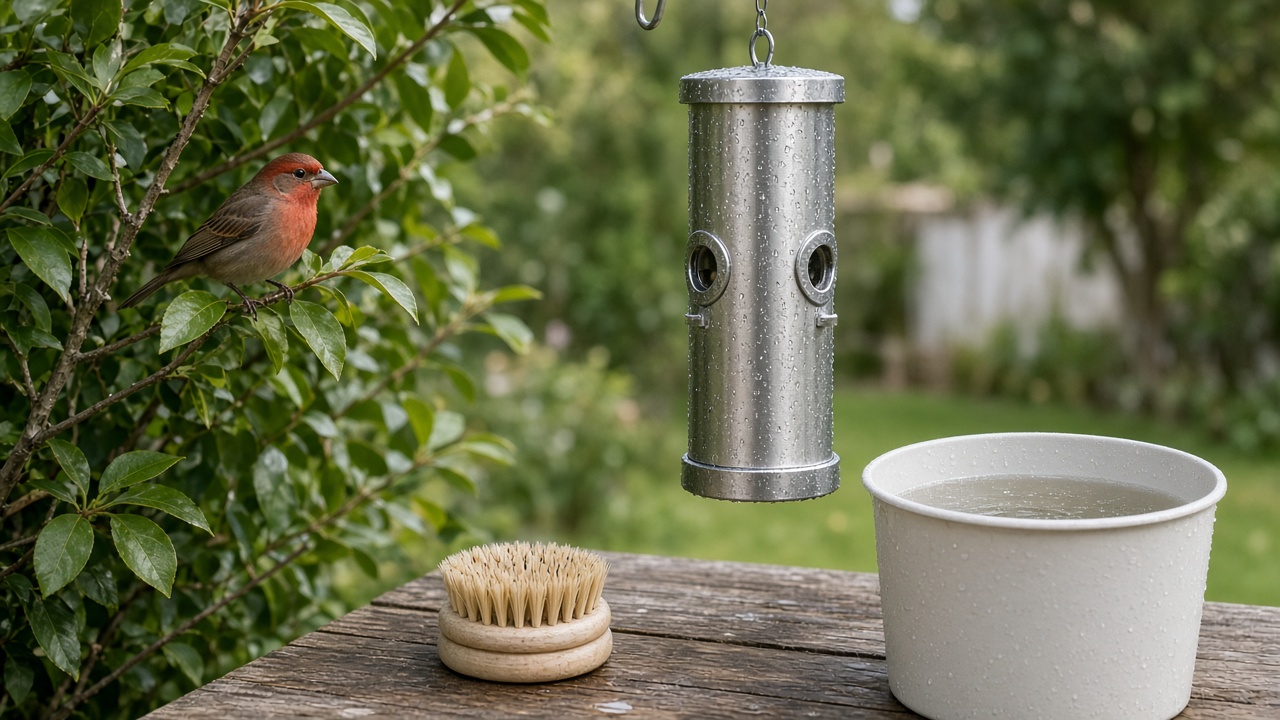
A feeder is a small room that many birds use in a day. They eat, they drop seed, and they leave droppings where the next bird eats. That is enough to move disease. It is not a reason to stop feeding. It is a reason to treat the feeder as something you wash, on a schedule, before anyone looks sick.
Project FeederWatch's disease page is the one to keep. Salmonellosis, from bacteria in the genus Salmonella, is a common cause of death at feeders, and the signs are easy to miss. A sick bird may look thin or strangely fluffed, may have swollen eyelids, and may let you walk close. Some infected birds look fine and still shed the bacteria. The usual path is fecal contamination of food and water, plus ordinary contact between birds. Outbreaks hit Pine Siskins, redpolls, and American Goldfinches hard enough that FeederWatch names them. House Finch eye disease is a different organism, Mycoplasma gallisepticum, seen in House Finches since 1994 and also in American Goldfinches, Evening Grosbeaks, and Purple Finches. The eyes go red, swollen, runny, or crusted, and in a bad case the bird cannot see. Avian pox shows as warty growths on bare skin, around the eye, at the base of the bill, on the legs and feet, and it can also form plaques in the mouth and throat. It spreads on contact, on a dirty surface, and in contaminated food or water. Avian influenza is a separate story, a virus of wild waterfowl that sometimes turns severe. FeederWatch points people to the Cornell Lab for current highly pathogenic outbreaks rather than asking a backyard watcher to diagnose a duck virus in a goldfinch.
If you do see a sick bird, the instruction is not to nurse it. Only a veterinarian or a federally licensed wildlife rehabilitator may legally treat a wild bird. Possessing most wild birds, unless you are under that direction, is illegal. FeederWatch says to take down the feeders that bird is using for a couple of weeks, so the flock spreads out, and to clean the feeders and the ground while they are down. For a bird you think will die without help, contact a rehabilitator. The page points to the Humane Society's state list in the United States and Nature Canada's provincial list.
Cleaning works, and the method matters. Researchers at Kutztown University, writing in the Wilson Journal of Ornithology in 2018, put Salmonella enterica on feeder perches and seed wells. They compared scrubbing with soap and water, a ten-minute soak in dilute bleach, and soap followed by the bleach soak. All three reduced the bacteria. The two that used bleach did better. Feeders that still carried normal feeding debris held more bacteria afterward than clean feeders, whatever the method. Debris plus soap alone could leave enough Salmonella to keep transmitting disease. FeederWatch's translation is practical. Scrub until you cannot see debris. Then soak or scrub with a dilute bleach solution. Rinse. Dry the feeder completely before seed goes back in. Do this when no one looks sick, not only after.
The recipes in print do not match word for word, and pretending they do would be sloppy. The Cornell Lab's classroom feeder page says wash about every two weeks. Soak in soapy water, rinse with one part bleach to nine parts water, dry completely, and wear gloves. Plastic and metal, it says, are easier to sanitize than wood, and some plastic feeders can go in a dishwasher. Audubon's winter 2021 piece, with Sharon Audubon Center rehabilitator Sunny Kellner and with Emma Greig of FeederWatch, says scrub most feeders with soap and water, skip the soap on a hummingbird feeder, then soak about fifteen minutes in a half-and-half mix of vinegar and water, rinse, and dry. Greig says a dishwasher is fine when the feeder can take the heat. The piece calls every other week a starting point for seed and suet feeders, and more often is better. Audubon's 2011 feeding tips, written by Steve Kress, say empty and clean at least in spring and fall, more often in a humid summer, scrub with dish detergent, and soak in a 10 percent non-chlorine bleach solution before a rinse and a dry in the sun. Chlorine bleach, non-chlorine bleach, and vinegar are three different liquids. What the sources share is scrub, a sanitizing soak, a real rinse, and a feeder that is dry. Pick the soak your feeder's materials can stand, and do not invent a fourth recipe.
The ground is part of the feeder. Kress says to rake spilled grain and sunflower hulls, especially in early spring, because uneaten seed goes soggy and molds. The goldfinch species account says the same thing more narrowly: rake if you want to protect goldfinches from disease at feeders. Do not dump old seed on the lawn and call it feeding the ground birds. Kellner, in the Audubon winter piece, says throw uneaten seed out rather than pour it under the feeder, and sweep the bits that fall. Mold is not always visible. A flat tray that birds can defecate on, left dirty, is the arrangement the disease page is describing.
Seed choice is part of cleaning, because waste is what you have to clean. Cornell's seed guide says black oil sunflower draws the widest variety and that mixes with red millet, oats, and other fillers get sorted and then spoil. Shelled sunflower hearts mold faster than seed in the shell, so offer only what will be eaten in a day or two, and do not put hearts in a tube where moisture sits. Corn is the food most likely to carry aflatoxin. Never buy it in a plastic bag, never let it get wet, and never offer planting corn marked with red dye. White millet on the ground is fine only in an amount that disappears in a day. Store the bags in metal cans with tight lids, cool and dry. Kress says not to keep seed from one winter to the next. Heat ruins sunflower. Damp grows the mold that kills birds.
Suet has a season. In hot weather it goes rancid, and dripping fat can wreck the waterproofing on feathers. That is Audubon's rule, not a preference. A summer pinecone of peanut butter and cornmeal is the substitute those notes allow. Hummingbird feeders are on a shorter clock: one part white sugar to four parts water, no red dye, and a wash every few days in very hot water so mold does not grow in the nectar.
Cats and chickens belong in this essay because they meet the same ground. Keep the cat indoors. Audubon is direct: bells usually fail, and cats take the birds feeding low and the birds stunned by glass. Keep backyard chickens away from the feeder area. Audubon's winter piece says they can carry avian diseases too. A clean tube next to a flock of hens under the tray is only half a plan.
None of this is glamorous, which is why it gets skipped. The birds will come back to a feeder you left empty for a weekend. The Cornell classroom page says so outright: an empty feeder over a break does not starve a wild bird that has other food. A dirty feeder over that same break can pass Salmonella to the goldfinches that trusted it. Wash it before they look sick. If they already look sick, take it down, call a rehabilitator if a bird needs care, and do not try to be the clinic.
Sources
- Sick birds and bird diseases, Project FeederWatch
- Preventing disease at feeders, Project FeederWatch
- Maintaining a classroom feeder, Cornell Lab K-12
- How to feed birds safely this winter, Audubon
- 11 tips for feeding backyard birds, Audubon
- Feeding birds: a quick guide to seed types, All About Birds, Cornell Lab
- American Goldfinch, All About Birds, Cornell Lab