Binoculars for the Birds You Already See
October 29, 2026
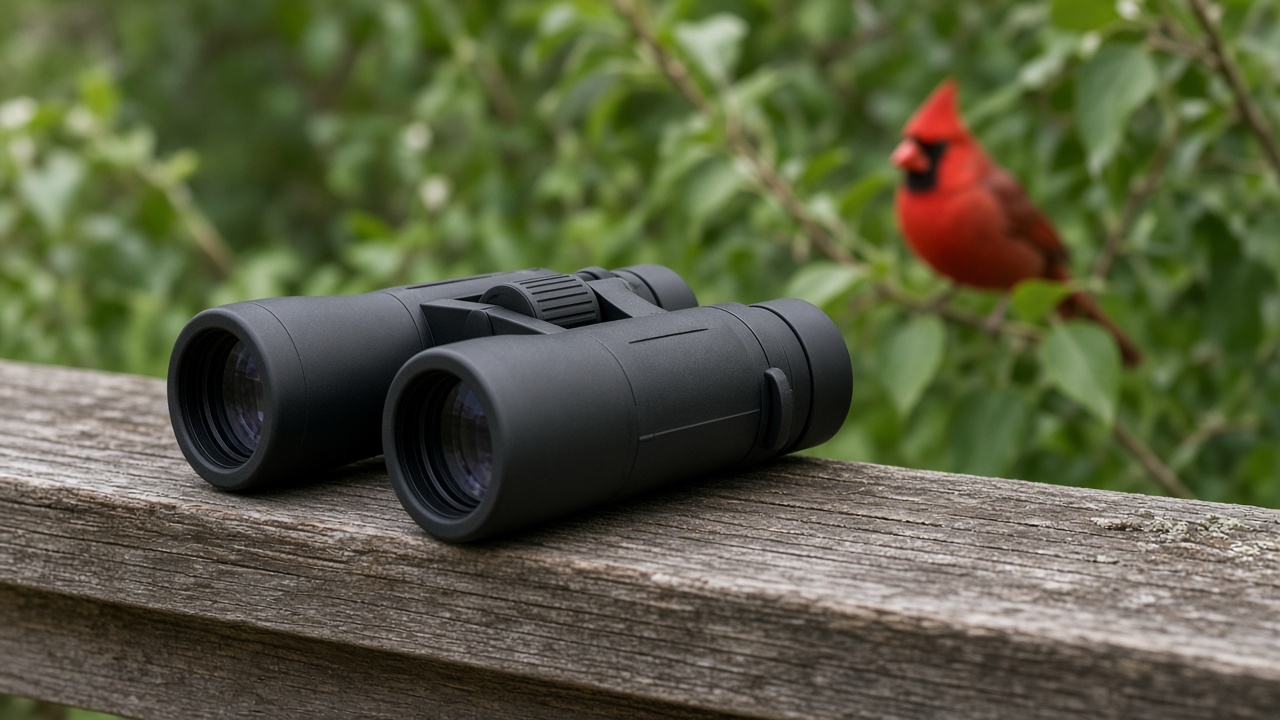
The birds at a feeder are close. That sounds like a reason to skip binoculars. It is the reason the close-focus number matters more than a huge magnification. The Cornell Lab's note on close focus puts the cutoff in plain language. When a bird is within about 15 feet, a pair that cannot focus that near gives you a blur instead of the bird. Many binoculars made for birding now focus to 10 feet or closer. A few reach about 5 feet, which is more than a yard needs and useful if you also look at insects. Close focus is not a luxury feature tied to the top of the price list. The Lab says it does not track neatly with price, so it is worth reading on the spec card of a modest pair.
The two numbers in a name like 8x42 are the magnification and the width of the front lens in millimeters. The Lab's field-of-view article calls those the two most important specifications, because they decide how big and how bright the picture is. For a yard, 8x is the steadier choice. Cornell's buying guide says most birding binoculars come in 8x and 10x, and that many people find 8x the better mix of magnification and a wide, steady view. Ten-power helps on distant shorebirds, hawks, and seabirds, and it also narrows the view and exaggerates the shake in your hands. A cardinal on a tray twenty feet away does not need the extra power. A goldfinch in a shrub, never still, needs the wider picture so you can find it again when it hops.
Field of view is the width of what you see, stated in degrees or in feet at 1,000 yards. Typical birding binoculars, the Lab says, fall between about 5.5 and 8.5 degrees, which is about 290 to 470 feet at 1,000 yards. At 20 feet, that is a view only about 2 to 3 feet across. A half-degree more field is about 8 percent wider. An 8-degree pair against a 6-degree pair is about a third wider, and the area you see is roughly three quarters larger. Those are the Lab's own rules of thumb. They matter at a feeder because the bird is rarely in the center when you lift the binoculars, and because extending the eyecups, or wearing glasses, eats into the stated field. The printed number is a best case.
The Lab's buying guide is stubborn about one step that no spec sheet replaces. Try the binoculars. People do not look through them the same way. The focus wheel has to move under your finger and stop where you leave it, because you will turn it every time, often while the bird is already leaving. Some pairs light the whole view. Others feel like a tunnel even when the center is sharp. Weight adds up. A modern 8x42, the guide says, is about 6 inches long and about 1.6 pounds. An 8x32 compact is shorter by about three quarters of an inch and nearly half a pound lighter. Pocket binoculars are smaller still. Lighter is not automatically better. Heavier glass is often the brighter glass, and a pair built only to be light can be fragile. A harness, rather than a thin neck strap, spreads the weight if you carry them past the porch.
Eyecups are a small thing that decides whether the pair works. If you do not wear glasses, you want cups that click out and stay. If you do wear glasses, you need enough eye relief to see the full picture with the cups in. Cheap accessories are a quieter failure. A strap you hate and lens caps that fall off get abandoned, and then the lenses live in a pocket. Warranties differ. The Lab notes that long warranties are common at the top of the range and harder for a maker to support at the bottom, both because of how the binoculars are built and because a replacement program costs money. If you want the pair for years, ask what the warranty actually covers before you decide the lower price was the saving.
None of this is a ranking of brands. The Lab's field-of-view piece names example 8x42 models only to show what a wide or a narrow field looks like on a shelf: a Nikon, a Kowa, a Vortex, a Celestron, a Maven, and others, spread from about 8 degrees down toward 6. Those names illustrate a measurement. They are not a prize list, and this Journal has not put those pairs on a railing and scored them. The test that counts is the one you do with a bird in front of you. The Lab suggests a shop that actually stocks binoculars, and mentions stores such as Wild Birds Unlimited, or a bird festival where several makers set up tables. A neighbor's pair, borrowed for ten minutes on a walk, tells you more than a photograph of the barrels.
Use them in the order the Lab's classroom page teaches, which is the same order a yard rewards. Find the bird with your eyes first. Binoculars are a poor search tool. Once you have the bird, do not look down at the barrels. Bring them up while you are still looking at it. Then turn the focus. At a feeder this is almost unfairly easy, which is the point. You are practicing the motion on a cardinal that will sit, so that a warbler in the lilac in May does not require a new skill. Close focus is what lets you stay on the goldfinch that drops to the grass under the tube, inside that 15-foot trouble zone, instead of backing up until the bird is a speck you could have seen anyway.
A camera feeder, if you have one, does not retire the binoculars. The camera records the perch. The binoculars let you look at the bird that would not land, the one in the hedge, the one the software labeled and you do not believe. Check the label against the bird, not the other way around. The Cornell species accounts are free. So is the decision to trust your own eyes once the focus wheel has caught up.
Skip the pair that will not focus near, skip the magnification you cannot hold still, and skip any purchase you were not allowed to lift. The rest is taste. The birds are already in the yard.