A Guide You Could Carry
November 6, 2026
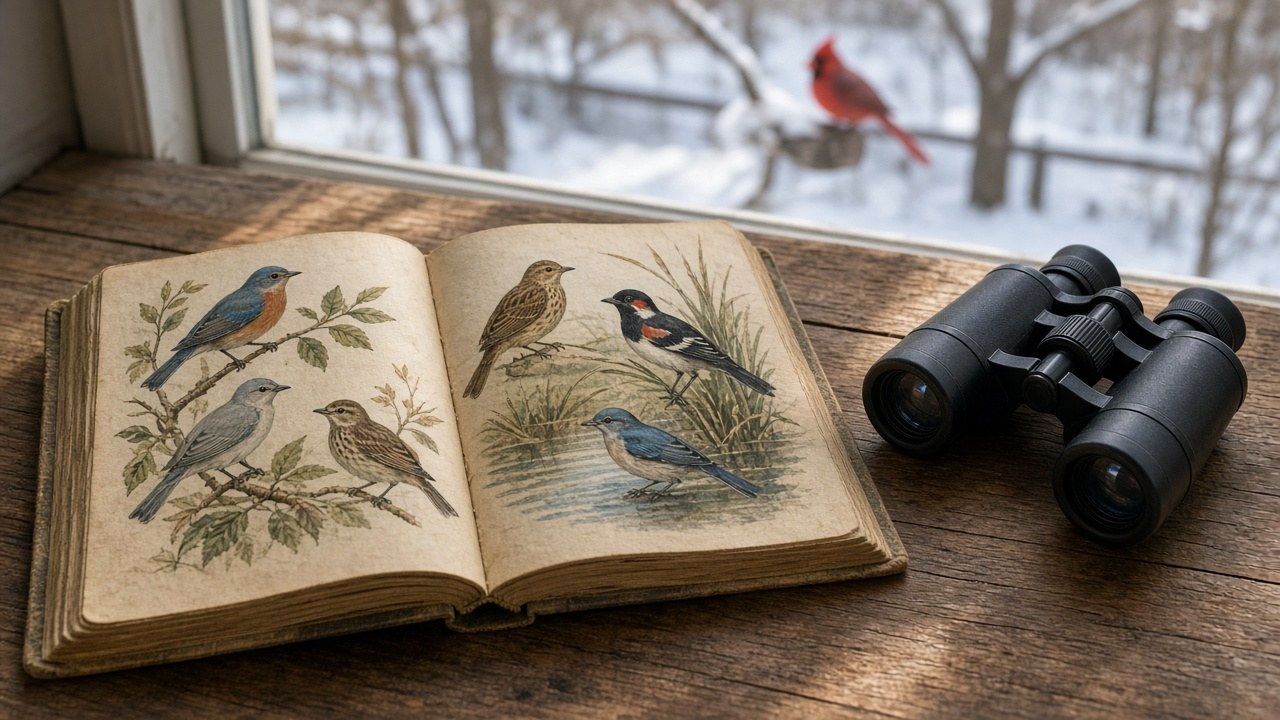
The field guide most people mean, when they say they learned birds from a book they could put in a pocket, is Roger Tory Peterson's. The pages that tell his life do not agree on the year he was born, and this article will not pick one for them.
The Linda Hall Library's exhibition Drawn from Nature captions a photograph "Roger Tory Peterson (1903–1997)" and, in the same section, calls him a 26-year-old when Houghton Mifflin published A Field Guide to the Birds in April 1934. The same library's Scientist of the Day note, written by Eric Ward and dated August 28, 2018, says he was born on August 28, 1908, in Jamestown, New York, that he was 25 when that book appeared, and that he died in 1996 at 87. An essay on the Roger Tory Peterson Institute's page about him also says he was born in 1908, in Jamestown, to immigrant parents. A caption that says 1903 and a biography that says 1908 cannot both be the birth year. The exhibition's "26-year-old" and the scientist note's "age of 25" cannot both be his age in April 1934. I am using the book, the pictures, and the publishing story, which those pages tell in the same way, and leaving the year alone.
What the pages agree on is the town and the habit. The Institute's biography says that as a boy he got permission from the local police chief to stay out after dark collecting moths, at a time when children were supposed to be inside. At 11 he found a clump of feathers on a tree, thought the bird was dead, and poked it. It was a Northern Flicker, tired from migration. The Institute quotes him: the bird jerked its head, looked at him, and left in a flash of gold. He called it a resurrection. The same biography says his first job, like a lot of Jamestown jobs then, was in a furniture factory, painting Chinese lacquered cabinets, until a supervisor told him to study art. He saved the money and went to New York.
Ward's note and the exhibition both put him, after high school, at the Art Students League and then the National Academy of Design, and in the Bronx County Bird Club, where he met Ludlow Griscom. Griscom identified birds with binoculars rather than a rifle, and he did it fast. Peterson's complaint, quoted by both Linda Hall pages, was that the bird books on the market were written for a collector. They ran a bird down by anatomy and measurements. He wanted a book that ran a live bird down by impressions, patterns, and distinctive marks. The Institute's essay says that by 1930, in Griscom's circle, he had decided the book had to be one a person could carry, with pictures "simple and patternistic."
The first edition covered the East. Ward says it covered birds east of the 90th meridian, about the Mississippi. The exhibition says the eastern United States, and that only four plates were in color. Peterson's own line, quoted there, is that in many instances the pictures tell the story without help from the letterpress. He cut the words down to the marks that separate species that look alike. Ward adds the phrase Peterson used for the method, identification by elimination, and a second quote: color was often an unnecessary, if not a confusing, factor. Arrows pointed at the marks. The exhibition says that system is what people later called the Peterson Identification System. Ward says the book was 167 pages, which is why it could go outdoors. The Institute says the first printing was 2,000 copies and that they sold out instantly. Linda Hall, in both the exhibition and Ward's note, says Houghton Mifflin printed 2,000 copies, would not pay royalties on the first 1,000, and saw the printing sell out within a week. Instantly and within a week are not the same sentence. Both pages are trying to say the Depression did not kill the book.
The exhibition's later section says a second eastern edition came in 1939, a western guide in 1941, and a third eastern edition in 1947. By then other publishers were in the same business: an Audubon land-bird guide in 1946, a water-bird guide in 1951, a western guide in 1957. Ward says that before Peterson died he had published three more editions of the eastern book, and that buyers have taken more than seven million copies of his field guides, with over 50 titles in the series. The exhibition says the Peterson guide is now in a sixth edition. The National Audubon Society's history timeline gives the 1934 book one line, that it popularized birding. The Institute's biography says that through five editions the eastern guide sold millions of copies in his lifetime. Five editions on that page, three further editions on Ward's page, and a sixth edition on the exhibition's page are not a contradiction if later editors kept the series going after he died. They are a contradiction if you try to make them all describe the same count of books he finished himself. This piece keeps them as three reports.
After the first guide, the Institute says, he worked for the Audubon Society for nearly a decade as education director and as art editor of the magazine. He had been a Junior Audubon member. The Institute says the dues were a dime. Later he was on the board and wrote a column. The same page says he was among the first to name DDT as the cause of the collapse in Ospreys, Bald Eagles, and other birds, and it reports his testimony to a United States Senate subcommittee: the side effects of most spraying programs go undocumented, more than 100 million birds are probably killed yearly, and, in the Institute's quotation, "I just could not live without birds." That 100 million is the Institute's account of what he told the Senate. It is not a figure this Journal has recalculated.
The exhibition ends the modern section with the guides that came after him. Golden Press in 1966, with Chandler Robbins, Bertel Bruun, and Arthur Singer, added color range maps and song diagrams. David Sibley's guide arrived in 2000. The point of Peterson's book was narrower than a monument. It was a way to name a bird that was about to leave, without shooting it first, out of a book that fit in a coat.